Wednesday, January 20, 2010

Wednesday's Tuesday Post... Quilting and Pioneers

Well, this post was supposed to go up yesterday, but I've been experiencing a severe lack of motivation... but I'm trying to get back on track and didn't want to just skip yesterday's post! Today's quilting post focuses on pioneers. As we've learned from the Non-Fiction Monday post, quilts were very popular among the pioneers for a variety of reason... the two stories up for review today make mention of one type of quilt in particular - the Wandering Foot.

Lowell, Susan.
The Elephant Quilt.
2008.
Farrar, Straus and Giroux.
Review copy borrowed from local library.


The year is 1859 and Lily Rose and her family are among the last of the pioneer families headed west in search of the California gold. The book got it's title from the simple motivator provided to Lily Rose from her older brother Lorenzo, who shouted "We're going to see the elephant." This was a popular American expression in the 1800's meant to have the thrill , or shock of a lifetime, working as a motivator to help pioneers keep their spirits up on the long, hard trip West. Throughout the journey Lily Rose and her grandmother work on sewing the "Elephant Quilt" that will act as a reminder of their travels, as quilts often did for pioneers - journaling the adventures they endured.

This is a wonderful book to include in a unit about quilts or even for children studying pioneers, as it features many important aspects of both!

Van Leeuwen, Jean.
Papa and the Pioneer Quilt.
2007.
Dial Books for Young Readers.
Review copy borrowed from local library.


Wandering feet (pioneers on the move) is yet again the topic of choice in this quilting story! Little Rebecca and her family are leaving behind most of their prized possessions to join the wagon train to head west to Oregon. As Rebecca befriends new bride Rachel, who oftentimes walks alongside her, she learns of just what it is that keeps Rachel's spirits up... a copper kettle (her only belonging making the trip with her) that's full of little scraps of fabric, all of which will be turned into a quilt... something fresh to start a new life that joins with reminders of their past and the journey that has been made. Rebecca soon desires to start a quilt of her own and, upon arriving in Oregon, works alongside her mother to create the quilt "Wandering Foot" quilt that will serve as a reminder of all that was endured on their long journey.

The authors note provided on the last page is a perfect compliment to the story, as it discusses different quilt patterns, but in particular, details about the "Wandering Foot" quilt that Rebecca and her mother sewed.

Learning/Reading Activity:
  • Today's post features an art project in which (older) children, grades 3-5 will create a 10x10 paper version of a Wandering Foot quilt! All of the pieces needed can be found on this Pieced Wandering Foot Pattern worksheet. Children will need construction or scrapbook paper to create the quilt, as well as a 10x10 sheet on which to glue the pieces.
  • These two books also set up a perfect discussion about the similarities and differences between Rebecca and Lily Rose - so, if you're looking for something more along the lines of reading comprehension activities, your child(ren) could complete this Venn Diagram to compare and contrast the two stories and characters.


If you're interested in finding out more information about any of the books reviewed or if you'd like to purchase the books, click the cover image for a link to Amazon.com. I am an Amazon Affiliate, so any purchases you make after clicking these images will result in my receiving a small percentage of the sale price!

Monday, January 18, 2010

Non-Fiction Monday: Introduction to Quilting

Sorry this post is coming to you so late in the day. However, I've been searching for the perfect book to use as an introduction to this week's theme - Quilts and just today came up with this title by Gail Gibbons... and being Martin Luther King Jr. Day, half of the libraries that had the book were closed! Anyways, it happened to be exactly what I was looking for, so the extra bit of travel to borrow the book was definitely worth it!

Gibbons, Gail.
The Quilting Bee.
May 2004.
HarperCollins Publishers.
Review copy borrowed from local library.


Gail Gibbons returns in yet another informational piece that has a great deal of appeal to children. Combined with the topic, the colorful illustrations add to the presentation of the informational and educational aspect of quilting. Not only will children be learning about the history of quilts, they'll also learn a bit about the process of creating a quilt... perhaps inspiring them to try their own hand at quilting!

Learning/Reading Activity:
  • Use this book as an introduction to quilting. Read and discuss The Quilting Bee several times and then have your child(ren) complete the study guide that goes along with the book, which can be downloaded here.


If you're interested in finding out more information about any of the books reviewed or if you'd like to purchase the books, click the cover image for a link to Amazon.com. I am an Amazon Affiliate, so any purchases you make after clicking these images will result in my receiving a small percentage of the sale price!

Sunday, January 17, 2010

Slapdash Sunday!

So, I've not been doing well with the whole "Slapdash Saturday" thing... so I figured I'd shoot for Sunday this week... better late then never! All of today's book are published by HarperCollins and were generously passed along to me for review for the 2009 Cybils Awards!

Gaiman, Neil.
Blueberry Girl.
March 2009.
HarperCollins.
Review copy provided courtesy of publisher.


As a much loved baby girl grows into a woman, Blueberry Girl offers a prayer of a brave, adventurous life - spent exploring, traveling, basking in the sunshine... all surrounded by wonder.

This is a wonderful book to gift at baby showers, Christenings and even graduations and can easily be personalized for that special little girl with a sweet, written message of your own!

Urbanovic, Jackie.
Duck and Cover.
January 2009.
HarperCollins.
Review copy provided courtesy of publisher.


Harold the alligator escapes the zoo after running into trouble with a dog - a hot dog that is, although there's obviously been a misunderstanding! He seeks safety in the home of Irene, owner to a whole slough of other rescued animals. It's not long before the zoo keeper comes after Harold... but the animals at Irene's have all taken a liking to Harold and are reluctant to give him up!

Children will love this funny book in which, Max, a now likely familiar character returns on yet another adventure - this time with Harold the alligator! The lively dialogue will only add to the appeal with this title as a read-aloud for young children!

Learning/Reading Activity:
  • A Pros/Cons journal activity can be downloaded here!
Kann, Victoria.
Goldilicious.
May 2009.
HarperCollins.
Review copy provided courtesy of publisher.


Pinkalicious returns in this delightful tale of a little girl and her pet unicorn! Girls will delight in the story of all things pink and gold! Unfortunately, boys will likely be less than thrilled with this story, as the language will seem giddy and too-girly to them!

There are two other books in this series that will instantly become must-haves for fans for Goldilicious or even Fancy Nancy fans: Pinkalicious and Purplicious.

Reading Activity:
  • Mid-winter break will soon be upon us! Choose a day and deem it "Partilicious." Pamper your daughter(s) and her friends! Ask each little girl to come to the party decked out in a different color of the rainbow. Refer to her as pinkalicious, redalicious, bluealicious, purplicious, orangelicious, etc. Create a cupcake station where each child decorates a cupcake that celebrates her! The girls could also make a necklace and magic wand to celebrate her! To avoid conflict over who gets what color, put all the different colors of the rainbow in a hat and have each child draw a color!
Gaiman, Neil.
Crazy Hair.
May 2009.
HarperCollins.
Review copy provided courtesy of publisher.


Crazy hair doesn't even begin to describe the hair inside this book! Comical images appear throughout with what seems to be photoshopped hair that appears so life-like you'll want to reach out and touch it! The story itself is very creative and funny, making light of crazy hairdos. Despite the craziness, I found a deep message lingering within - make the best of a bad situation - if you're having a bad hair day, use your imagination to come up with a creative explanation! The funny rhyming text combines fun into crazy hair, making this a perfect read-aloud for a Friday afternoon at school!

Reading/Learning Activity:
  • After reading this book, use it as the basis for a family craft project! The worksheet and directions can be downloaded here.
Torrey, Richard.
Almost.
May 2009.
HarperCollins.
Review copy provided courtesy of publisher.


Almost grown-up.
Almost ride a bike.
Almost like vegetables.
Almost the best at karate.

These are just a few of things that almost six-year old Jack can almost do! Children of all ages will appreciate the real story being told here, whether six or twelve! There's an important lesson to be learned... it's okay to enjoy being young, you still have lots of growing up to do - even as an adult! Coupled with the story, very colorful illustrations depict Jack's emotions perfectly and will allow children to connect to this story on a personal level!

Learning/Reading Activity:
  • Discuss with your child(ren) the things he/she can do now and the things he/she can ALMOST do. Determine a time/age in which these "almost" activities will be able to be done... (i.e. have an allowance, walk to a friend's house alone, ride a bike without a helmet, etc.). Along with determining when these activities can be completed, discuss the reasons why, at this point, they can't.


If you're interested in finding out more information about any of the books reviewed or if you'd like to purchase the books, click the cover image for a link to Amazon.com. I am an Amazon Affiliate, so any purchases you make after clicking these images will result in my receiving a small percentage of the sale price!

Wednesday, January 13, 2010

More with Shapes and Tangrams

I'm realizing as I put together these posts that you might not wish to use the books in this order! It's probably best if you introduce and then revisit shapes and how they can be combined to make "things" before moving on to the concept of tangrams...

Perhaps it would be best to use today's review of Dayle Ann Dodd's The Shape of Things alongside Stuart J. Murphy's Circus Shapes and save Grandfather's Shape Story to use after reading Three Pigs, One Wolf and Seven Magic Shapes! Of course, it's up to you! You know what where your kids are and what they need!

Dodds, Dayle Ann.
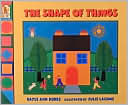
The Shape of Things.
1994.
Candlewick Press.
Guided Reading Level H.
Review copy borrowed from local library.


Another wonderful book to introduce and review the basic geometrical shapes (square, circle, triangle, rectangle, oval, diamond), The Shape of Things, is a perfect book to incorporate at the beginning of a thematic unit focusing on tangrams and geometry! Throughout the story, these shapes are introduced in simple, everyday objects that your child(ren) will certainly be familiar with.
A square is just a square,
Until you add a roof,
Two windows and a door,
Then it's much, much more!

A circle's just a circle,
Until you add some lights,
Chairs high and low,
Round and round they go.
Not only is the use of shapes in everyday life an important theme of this book, equally important is the concept of using your imagination to visualize the shapes that make up those everyday objects! Imagination is greatly used throughout any theme focusing on tangrams, so this is definitely book I'll be using!

Reading/Learning Activity:
  • Provide your child with a large piece of construction paper. Using the handout that can be downloaded here, have your child create a scene (picture) using only the shapes provided! Allow them to be creative in what they create and encourage them to use color on the shapes to help make the picture more visual!
Maccarone, Grace.
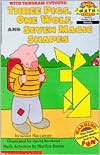
Three Pigs, One Wolf and Seven Magic Shapes.
1997.
Scholastic, Inc.
Guided Reading Level: K
Review copy borrowed from local library.


As in the original telling of The Three Little Pigs, Maccarone's three little pigs set off to seek their fortunes, each setting off in his/her own direction! However, rather than meeting a man, each of these three little pigs meet up with a different animal - a duck, a rabbit and a swan. Rather than in the traditional tale, these pigs are each given the same material (seven magic shapes - the tangram puzzle). They don't quite meet up with the Big Bad Wolf, but rather his very good friend, Big Brad Wolf! While each of these pigs does create a structure with his/her seven magic shapes, only one is once again able to outwit the wolf.

In this unique take on the tradition tale of The Three Little Pigs, Grace Maccarone uses a very familiar tale to teach children about tangrams in a fun, unique manner! It's sure to be a hit by children, as they'll readily pick up on the familiar story with a twist!

Reading/Learning Activity:
  • Hit on two skills in one with this book! Download the tangram puzzle square here. Have your child cut apart the puzzle, and then, using the pieces, retell the story of Three Pigs, One Wolf and Seven Magic Shapes. As they are practicing the act of retelling the story, challenge them to use their tangram puzzle pieces to recreate the animals who provided the pigs with the magic shapes and the objects that the pigs constructed with the shapes! If your child(ren) need help with this, encourage the act of retelling and then, once they have retold that portion of the story, allow them to see the object made with tangrams and copy it using his/her own pieces! This acts great as a reading comprehension strategy and also integrates math into the activity!


If you're interested in finding out more information about any of the books reviewed or if you'd like to purchase the books, click the cover image for a link to Amazon.com. I am an Amazon Affiliate, so any purchases you make after clicking these images will result in my receiving a small percentage of the sale price!

Tuesday, January 12, 2010

Tangramables Tuesday

In order to be most successful teaching children about tangrams, I think parents will be looking for a resource that's geared more towards teachers... hopefully this will do the trick.

Martschinke, Judi.
Tangramables.
1990.
Learning Resources.
Review copy obtained from personal teaching resource collection.


Geared specifically towards parents and teachers, Tangramables, is a resource divided into three main sections: cover up, imagination, and shapes from shapes. The way that the sections are broken down allow for the use of this book with children in Kindergarten through eighth grade.

Cover Up (intended for Kindergarten through 1st grade, usable at all grade levels)
This section of the book involves placing tangram pieces on top of the outlined tangram pieces. Students need to slide, turn and flip the pieces (transformational geometry concepts) in order to place them correctly. The first few pages involve using only one piece at a time. The pages that follow start combining shapes until, eventually, all seven pieces are used at the same time.

Young children need only to cover the shapes drawn in the bookt o complete the task. As students get older they should be bale to answer such questions as

How many pieces are used?
How many triangles are used?
squares?
parallelograms?
How many different size triangles are used?
Which pieces have sides the same length?
Can I fit the piece on top of the drawing if I turn it a half turn?
a quarter turn?
Can I fit the piece on top of the drawing if I flip it?
Imagination (intended for grades 2-4, usuable at all grade levels)
This section of the book involves combining tangram pieces in such a way that the student's imagination makes the completed work look like something familiar to the student. Drawings of objects or animals are on the pages to help the child use his/her imagination when visualizing the completed work. The outline of an object or animal made by tangram pieces is shown on the page. The child is to cover the area inside the outline with tangram pieces and for the object or animal specified. The outlines of the tangram pieces are shwon on the first few pages only. After that the child must use what he/she knows about the pieces (length of sides, size of angles, etc.) and the ways they can be manipulated (slides, turns, flips) to fill in the outline of the object or animal.

Children can use balnk paper to lay the tangram pieces on, rather than the Tangramables book. Then they can trace their work for handing in or for displaying. If desired, details can be drawn into the "tangrammable" drawing and backgorund artwork can be added.

After using their imagination and experiencing ways to combine tangram pieces in completing "tangrammable" objects, students can make their own "tangrammable" sheets for classmates to try.
Shapes from Shapes (targeted toward grades 3-5 but usable at all grade levels)
This section involves making geometric shapes from tangram pieces. Students are asked to use specific pieces or a specific number of pieces to cover the inside of a geometric shape outlined on the page. By doing this students will experience ways various shapes are formed. Relationships of sides, angles and areas will be experienced when completing the pages. Although students are not asked what they are doing or why, manipulating the pieces will help them understand concepts of length, angle measure, perimeter and area. When the teacher feels students need to measure lengths, measure angles, calculate perimeter, or calculate area, various pages int his section can be completed on blank paper, traced and measured.
As I'm sure you notice from the author's description of each of the three sections covered in this book, the use of tangrams by children varies greatly by age. For the youngest of children, the main purpose is to introduce children to various shapes and the ways in which shapes can combine to create "things." As children grow older, they benefit from use of tangrams to learn geometric principles. Hopefully you'll find this a resourceful tool when teaching your child(ren) about tangrams as part of a math curriculum.


If you're interested in finding out more information about any of the books reviewed or if you'd like to purchase the books, click the cover image for a link to Amazon.com. I am an Amazon Affiliate, so any purchases you make after clicking these images will result in my receiving a small percentage of the sale price!

Monday, January 11, 2010

Non-Fiction Monday: Introducing Shapes and Tangrams

Week 2 of Themes!!! This week, the theme I'm sharing with you all is geometry (shapes) and tangrams. I was originally going to go just with tangrams... however, in order for the youngest of children to enjoy tangrams, they do need to have a basic understanding of shapes! From there, you can go on to introduce what tangrams are!

Murphy, Stuart J.
Circus Shapes (MathStart Series).
1998.
HarperCollins Publishers.
Review copy borrowed from local library.
Guided Reading Level: H


Teaching children about shapes can prove to be a bit more difficult that it might ordinarily seem! The use of an interesting topic to show them shapes in an everyday way is exactly what you'll probably need! Here, Stuart J. Murphy introduces many everyday shapes by taking readers to the circus. Circus animals perform a variety of tricks, all of which result in the production of different shapes.

While not all of the shapes found in a tangram puzzle are presented in this book, the book does serve as a perfect introduction or review of many basic shapes. The last two pages also invite readers to search for different shapes as a way to reinforce the shapes (circles, triangles, rectangles, squares) that have been mentioned throughout.

Reading/Learning Activities:
  • Test your child(ren)'s knowledge of and understanding of circles, squares, rectangles and triangles by asking them to count the number of each that make up "Tango the Clown."
Sargent, Brian.
Grandfather's Shape Story.
2007.
Scholastic, Inc.
Review copy borrowed from local library.


A little girl is introduced to tangrams through her grandfather's "Shape Story." As the story goes, a poor man in a far away country found pleasure in life's simple things. One day, as he was sitting around, the man heard someone calling for help - a rooster, seeking shelter from a troublesome fox. The man took in the rooster to his home, closing the windows and using only candlelight to see. Together, the two sit at a table, the man drinking tea. The rooster is so thankful for the man saving his life, he wants to grant the man one wish. The man thinks and thinks about what his one wish should be. However, rather than actually revealing the wish to his granddaughter, he passes the tangrams along and tells her you choose, encouraging the little girl be creative with creating something from the tangrams.

This book is ideal to use when introducing tangrams to children for many reasons. First, the tangram puzzle is introduced as a "whole" square, but all of the different shape pieces can be detected due to their coloration. Secondly, the pieces of the tangram puzzle are separated and labeled so children have the opportunity to become familiar with the shapes. Finally, all of the illustrations are made from colored tangrams, allowing children to visibly see the how different shapes put together can "form" objects.

Learning/Reading Activity:
  • Print off the tangram puzzle, found here. I would suggest printing the puzzle on cardstock or heavy weight printer paper so it is more durable.
  • Have your child color the puzzle using the following directions: 1 large triangle red, 1 large triangle blue, 2 small triangle red, 1 small triangle blue, 1 medium triangle yellow, 1 parallelogram yellow, 1 square green.
  • Using page 6 of Grandfather's Shape Story, help your child label each of the pieces of the tangram puzzle. This will allow them to become familiar with the different shapes.
  • Allow your child(ren) to experiment with the tangram pieces - encourage them to play around with the shapes and see what they can "make." Allowing them freedom to explore the "tools" freely some will ensure that when you do try to use the tangrams educationally, they will be less apt to "play" while you're teaching!


If you're interested in finding out more information about any of the books reviewed or if you'd like to purchase the books, click the cover image for a link to Amazon.com. I am an Amazon Affiliate, so any purchases you make after clicking these images will result in my receiving a small percentage of the sale price!

Sunday, January 10, 2010

A to Z Challenge

* For details about this challenge, click on the image above!

26 Authors

Akpan, Uwem - Say You're One of Them
B
C
D
Efaw, Amy - After
F
Gray, Shelley Shepard - Winter's Awakening
Harris, Lisa - Love Finds You in Revenge, Ohio
I
J
Kingsbury, Karen - Take Three
Lewis, Beverly - The Telling
M
N
O
Picoult, Jodi - House Rules
Q
Rosenberg, Liz - Home Repair
S
T
U
V
W
X
Y
Z

26 Titles

A
B
C
D
E
F
G
Holiday, Florida (Love Finds You series), Sandra Bricker
I
June Bug, Chris Fabry
K
Liberty, Indiana (Love Finds You series), Melanie Dobson
M
N
O
Poetry, Texas (Love Finds You series), Janice Hanna
Q
R
Spring's Renewal, Shelley Shepard Gray
Treasure Island, Florida (Love Finds You series), Debby Mayne
U
V
Whistlin' Dixie in a Nor'easter, Lisa Patton
X
Y
Z


If you're interested in finding out more information about any of the books reviewed or if you'd like to purchase the books, click the cover image for a link to Amazon.com. I am an Amazon Affiliate, so any purchases you make after clicking these images will result in my receiving a small percentage of the sale price!
Every Month is a Holiday Perpetual Reading Challenge


*For details about this challenge, please click on the above text.

February


Of course, for February, my "notable" had to be Valentine's Day! I'm a huge fan of the whole Valentine's Day concept, even though I don't have a valentine of my own... although, I will be honest... I'm working on that one!

I've had this book laying around for about two years now... bought it right after Valentine's Day in 2008. However, being that it was after Valentine's Day, I opted to save it for "next year." "Next year" passed and the book remained on my shelf, but upon signing up for this challenge, I just had to pull it from the shelf!

Two short novels, My Funny Valentine and My Hero are wrapped up in this one book. In My Funny Valentine, single mother Dianne Williams has a tremendous amount of pressure put on her to find a date to the community center's annual Valentine's Day dinner. Determined not to let her mother and children arrange a date, Dianne asks a random gentlemen she meets after locking her keys in the car one evening. As luck would have it... she winds up with more than just a date for the Valentine's Day dinner! In My Hero, Bailey York portrays the character of a romance novelist. However, romance seems to be falling short in her novel. After a friend suggests that she needs a "hero," or real-life model for her character, Bailey gets more than she bargained for... gaining not only a model for her character, but ultimately a real-life hero of her own.

This was definitely the mushy, too-good-to-be-true type of Valentine's Day read I needed to get through the holiday without a valentine!

January

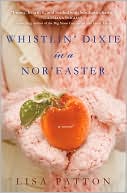
The January "notable" that I chose to work from was "snow." For those of you not living in coastal areas, a Nor'Easter is a huge coastal snowstorm... Living in NY, I've experienced my share of them, so I knew this book would definitely cover the "snow" notable!

I've been wanting to read this book after a friend's recommendation and happened to find it on the shelf of a bookstore that was going out business, reduced 30%. With a gift card, I couldn't resist the purchase, knowing that its January 2010 release date meant it'd be months before I could snag it from the library!

33-year old Leelee Satterfield is emotionally devastated when her husband announces he's moving the family from their life-long home of Memphis, Tennessee, north to Willingham, Vermont to run a quaint inn. However, loving her husband as she does, Leelee goes along, asking far too few questions (something she will deeply pay for)! As Leelee, her husband and their two young daughters set up home in Vermont, they quickly learn that it couldn't be farther from "home." Nor'easters, mud season, stick season and Skin-So-Soft quickly become some of their most familiar vocabulary in their new home. Just when Leelee feels as though she's beginning to adapt to her new home, she suffers a near-devastating blow, that quickly turns her into a stronger, more self-sufficient woman than she ever dreamed of.

Let's just leave it this way... I love the book so much, I've personally contacted the author via e-mail requesting a sequel!


If you're interested in finding out more information about any of the books reviewed or if you'd like to purchase the books, click the cover image for a link to Amazon.com. I am an Amazon Affiliate, so any purchases you make after clicking these images will result in my receiving a small percentage of the sale price!