I've got a bunch of new books that have come in the mail in the past two, two and a half weeks, so I've decided to participate in
The Printed Page's Mailbox Monday! Hopefully this will keep me more up-to-date on reviews of materials that I've been sent.

Halfmann, Janet.
Little Skink's Tail.
2007.
Sylvan Dell Publishing: Mt. Pleasant, SC.
Ages: 4-8
Genre: Fiction, Science - Animal Adaptations
Guided Reading Level: N/A
Review/Summary:
Most recently named 2009
Learning Magazine's Teachers' Choice Award Winner,
Little Skink's Tail focuses on skink's (a lizard) ability to adapt to its surroundings and protect itself in times of danger. For those who didn't know, lizards break their tails when faced by an enemy as mean of protection. This book could easily be used in part of a science curriculum that focuses on ways in which animals survive and adapt in their environment(s). A learning guide to supplement
Little Skink's Tail can be found
here.
Little Skink has been spied by a crow. She has to escape and does so just as the crow snaps down to pluck her away. However, Little Skink has a trick - her tail can snapped off to protect her from danger. However, once her tail is gone, Little Skink realizes just how much she misses it and goes around imagining a new tail for herself. She tries on tail after tail - a rabbit's tail, a squirrel's tail... and many more. However, just as she decides that none of the other tails are right for her, she catches sight of a her shadow on a sunny rock. Lo and behold, her new tail has started growing and it's just right!

Maccagnone, Garasamo.
The Suburban Dragon.
1992.
Crate & Fly.
Ages: 4-8
Genre: Fiction - Realistic
Guided Reading Level: N/A
Review/Summary:
Maccagnone has written this story for his own children. One boring, rainy day when there's nothing to do. The children in the story, inspired by his own, settle down to listen to a story read to them by their mother. Soon, a dragon sneaks up behind them on the couch and snatches away mother. The children come up with a plan to rescue their mother and in doing so, eventually trap the dragon - who turns out to be their father!
This is a cute story that certainly seems like it's capturing one of those rare childhood memories that we all have experienced. It reminds me of playing Boogie-Man with my parents when I was a child! Very cute and well worthy of a read!
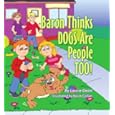
Dean, Laurie.
Baron Things Dogs are People TOO!
2008.
Big Tent Books: Savannah, GA.
Ages: 4-8
Genre: Fiction - Realistic
Guided Reading Level: N/A
Summary/Review:
Baron is part of the family. Isn't he just like a son? That's what he thinks! However, he's acting such like a child that Mom and Dad decide that Baron needs to learn some manners and send him off to obedience school. By the time that Baron's completed his schooling and returns home, he feels lonely - he doesn't have any friends. However, Baron quickly turns that around when he befriends Billy one snowy day.
Oh, how this book reminds me of my dog, Niko. She definitely thinks she's a human. Here are a few pictures of her in her most human poses! Kids will go crazy for this human-behaving dog!

Lesson Plans/Book Activities:
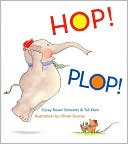 Schwartz, Corey Rosen.
Hop! Plop!
2006.
Walker & Company: New York, NY.
Ages: 3-6
Genre: Fiction
Guided Reading Level: N/A
Summary/Review:
My good blogging friend, Corey Schwartz over at Thing 1 and Thing 2 sent me a copy of her book!
This book takes us on an adventure with polar opposites, Mouse and Elephant. Finding themselves bored, this duo of friends set out to explore the playground! The rhyming text as Mouse and Elephant explore the playground makes for a great introduction to word families and the concept of rhyming. Together, the two explore the seesaw. Elephant hops on and as a result of his weight, Mouse bops to the ground! Mouse tries to gain weight by eating a watermelon, but as a result of all the slurping, he begins burping! When the duo decides that the seesaw is faulty, they move on to the swing and another adventure begins!
I would use this book not only for a read-aloud, but also as an introduction at the Kindergarten or 1st grade level, depending on the students, to several different word families: -op, -urp, -unch, -ip, -ing, -ush, and -ide. The book also introduces the concept of weight difference between Mouse and Elephant and the consequences of the varying weights at the playground. For example, Mouse is stuck at the top of the seesaw, Elephant breaks the swing! Cause-and-effect could also be explored using this book!

Worton, Barbara.
Too Tall Alice.
2009.
Great Little Books, LLC.
Ages:
Genre:
Guided Reading Level:
Review/Summary:
This book definitely belongs in any 4th grade and up classroom! It will indeed show the girls in the class the message that Worton dedicates to "all the too tall, too small, too skinny, too fat, too smart, too silly girls who deserve to see, really see, and love themselves" - that true beauty comes from within. While I think younger kids would get a kick out of the story itself, I don't think that kids younger than at the 4th grade level would take the message and really start to understand it. I also think that this could be a good self-esteem builder even for a teenager who is struggling to define herself and fit in - I think I would have benefited from this book as a teenager!
Alice is just 9 years old and already she's 4 inches taller than all the other girls in her class. All of the things that adults tell her to make her feel better have the opposite effect! But it gets worse... one night she hears her parents and the neighbors discussing how horribly tall she really is - she's going to be "a string bean, a bean pole, a twig, a long drink of water, a toothpick." That night, Alice cries herself to sleep and wanders off to dreamland - to the place where the tall girls live. Even though she's the shortest, she's also the youngest and has much time to grow. The older girls help Alice to find herself amongst the throngs on people that they have her look out on. When she takes this time to really look at herself, she sees all that she is... and all that she can be. Ultimately, Alice takes away the message that Worton wants reader to find... that you are special just the way you are and that your true beauty comes from within, not how tall you are, or how thin you are, or the color of your hair, but what's really found deep within yourself.
If you're interested in finding out more information about any of the books reviewed or if you'd like to purchase the books, click the cover image for a link to Amazon.com.

 Anderson, Sheila.
 Anderson, Sheila.
 Anderson, Sheila.


 Posts
Posts



