Saturdays will be known as Slapdash day! I receive a lot of ARC's from publishers and am always eager to share with my readers the great new books available! However, it is unlikely this year that many of those titles will fit in to my weekly themes, so I'll feature a half-dozen or so on each Slapdash Saturday. I still have a close to two dozen to review from 2009, so I'll start out 2010 by getting those 2009 titles out there!
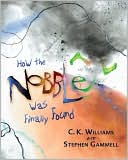 Williams, C.K.
How the Nobble Was Finally Found.
September 2009.
Harcourt Children's Books.
Review copy provided courtesy of publisher. This unique story allows imaginations to run wild, as children are introduced to a nobble, who's been alone for some four thousand years, existing, but likely unseen. When he finally decides to embark on the world, children will watch the adventure unfold as he struggles to make friends and communicate in a near-foreign world. The funny language that the nobble uses in attempt to communicate with a little girl who decides to befriend him is sure to have children chuckling
"And... here where..." the Nobble said.
"What?" said the girl.
"And... when whether," said the other Nobble.
The little girl said, "What?" again.
"If maybe?" our Nobble said.
"Therefore instead?" said the other.
"What, what?" said the girl, who was a bit exasperated by now.
All this... in their attempt to say goodbye! Children will find it so funny, in fact, they'll likely be using the language themselves in attempt to be funny with their parents and peers!
Learning/Reading Activity:Encourage your child to use his/her imagination in a different way than the little girl in the story to help the Nobble. She figured out a way to introduce him to another Nobble by using a telephone and giving very explicit directions to talk him through getting to the other Nobble. Ask him/her to write a story or draw a picture... the key here is, they can't use the telephone for their communication method AND he/she must remember that the Nobble is very unfamiliar with our language. How will your child befriend the Nobble?
 Naraynan, Manjula.
The red Red Car.
October 2009.
AuthorHouse.
Review copy provided courtesy of publisher.The red, Red Car is red in more ways than just color. Here, the color red represents his anger - his frustration, at not always being the best. This unique book teaches children about anger management in a way that they can relate to, as children are often more than familiar with road signs and stop lights, often which can mimic the feelings of anger, especially in children who sometimes have trouble expressing themselves and dealing with anger effectively. After a visit to the "doctor" the red, Red Car comes to recognize that huffing and puffing won't help him win the race, but rather that finding a way to deal with your anger and frustrations will really take you farther in life!
Learning/Reading Activity:Children often times have trouble expressing their anger and effectively coping with anger when it does arise.
Here, you will find a creative activity in which children learn from comic-strip dinosaurs how to "cool down," much like the red, Red Car did in the story and to more effectively handle their anger. Read the story with your child. Discuss the methods being used. Then, encourage your child to color the comic (and perhaps even cut it apart and turn it into a book of his/her own).
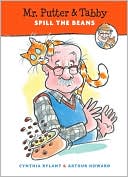 Rylant, Cynthia.
Mr. Putter and Tabby Spill the Beans.
August 2009.
Harcourt Children's Books.
Guided Reading Level: J
Review copy provided courtesy of publisher.Mr. Putter and his dear friend Tabby return for yet another one of Mrs. Teaberry's adventures! Bored and lonely, Mrs. Teaberry convinces Mr. Putter to join her at a class in which they will learn 100 ways to cook beans. Why he agrees, he's not sure, as he doesn't know why anyone would need to know 100 ways to prepare beans. However, being that he always does as Mrs. Teaberry wishes, he goes along... for the adventure of a lifetime!
Learning/Reading Activity:I've always believed it's important to get parents involved in students' learning activities. One way to do this is to send home a little activity each week (perhaps on a Wednesday, and returning to school on Monday morning) that the entire family can work on together over an extended period of time. It might be interesting to have Mr. Putter and Mrs. Teaberry's pets as classroom "mascots" that can be the center of the daily/weekly take-home journaling activity. There are many great stories in this series, one of which could be read during each week of the school year and a parent activity that could go along. In this particular activity, children and their parents will be asked to come up with a list of 20 ways to prepare beans, all of which will then be compiled into a list of 100 different ways to prepare beans. If different ways are not found from student's homes, it could then be turned into a computer lab project, searching for bean recipes! The parent activity letter can be downloaded
here!
 Lee, Sally O.
Stop It!
September 2009.
Lee Publishing.
Review copy provided courtesy of publisher.George and Anabel are your typical sibling pair, one constantly bullying, the other constantly being bullied. One day, after Anabel has been bullied one too many times, she loses it with George, hollering "STOP IT!" after George has gone too far, taking to bullying Anabel's cat Lulubell. However, when George shows remorse, rather than holding a grudge, Anabel eagerly accepts him to join in on the game and appoints him King, making him feel welcome and ultimately showing that even though the two have their differences, there's no reason they can't get along.
Learning/Reading Activity:Bullying is a topic that in today's world, shouldn't be taken lightly. Children need to learn to respect each other and the differences that make us who we are. In your classroom or home, institute the idea of "
The Talking Stick." When you start to notice your child(ren) beginning to bully, pull out the talking stick and have them take turns using the stick to effectively communicate and eventually resolve the problem. See the roles below:
The One Being Bullied:
- Give the talking stick first to the victim. Ask him/her to express in words how they feel about what is going on. Are they mad? Sad? Why?
The One Bullying:
- Allow the "bully" a chance to explain why he/she was behaving in the way he/she was. (Is there a reason for this behavior?).
- The "bully" must ultimately apologize for his/her behavior.
Next, ask the two parties to come up with a solution and work together, showing that they can get along!
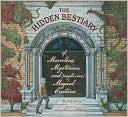 Young, Judy.
The Hidden Bestiary of Marvelous, Mysterious and (maybe even) Magical Creatures.
September 2009.
Sleeping Bear Press.
Review copy provided courtesy of publisher.The whole I-Spy! concept takes on an entirely new approach in this incredibly fun book of marvelous, mysterious and magical creatures! Readers embark on an adventure with explorer Basil Bernard Barnswhitten to track down these (sometimes) alive, extinct and possibly non-existent creatures camouflaged amidst their true-life surroundings. The book is not only a unique way to introduce children to this explorer, but also encourages them to explore and take away from poetry, information that will assist them in locating each of these creatures! I would suggest parents read the book first themselves and locate the creatures, so that when little eyes become frustrated at locating the creatures in their camouflaged habitats, parents are able to guide them to locating the creatures!
Learning/Reading Activity:Read the clues aloud to your child(ren). Encourage them to try and figure out what each creature is (without first looking at the index at the back of the book). Once they are able to locate each of the creatures, ask them which creature they'd like to learn more about. Work together to explore the internet and research the particular creaturing, pulling into a file: photos, facts (weight, height, etc).
You can also use the
Teacher's Guide provided courtesy of Sleeping Bear Press for more
wonderful activity ideas!
 Schories, Pat.
Jack Wants a Snack.
September 2008.
Front Street (Boyds Mills Press).
Review copy provided courtesy of publisher. Illustrator of the famous
Biscuit series, written by Alyssa Satin Capucilli, returns again for a fourth time after striking out on her own to author the
Jack series, a wordless series geared toward the youngest of children. Here, mischievous, spotted terrier, Jack gets himself into a pickle at the need of a snack! The book is ideal for young children, as it acts as a perfect introduction to the concept of a story, rather than placing huge emphasis on the idea of words. This will initially draw children in to the idea of reading, without allowing them to experience frustration from not being able to "read." Though it is geared toward younger children, the book could easily be used with older children as well.
Learning/Reading Activity:This book is ideal for introducing the idea of story mapping to focus on different elements that make up a story - setting, characters, problem, events and solution. Being wordless, children will be prompted to use context clues from illustrations to draw inferences about the story. If working with children in a classroom setting, have them join you on the carpet... if at home, share in a location where child(ren) can clearly see all of the illustrations. "Read" through the book page-by-page, discussing the different story elements. Explain the importance in allowing all feasable thoughts to act as the setting, the problem, events and solution! Send children back to their seat with the
Story Map Worksheet. Ask them to complete a story map of their own that coincides with the wordless book,
Jack Wants a Snack. If you're interested in finding out more information about any of the books reviewed or if you'd like to purchase the books, click the cover image for a link to Amazon.com. I am an Amazon Affiliate, so any purchases you make after clicking these images will result in my receiving a small percentage of the sale price!

 Rylant, Cynthia.
 Bunting, Eve.



 Posts
Posts



