Showing posts with label MathStart. Show all posts

Tuesday, February 23, 2010

Mitten Math

Yes... you can actually use mittens to teach simple mathematics concept!

Murphy, Stuart J.
The Missing Mittens.
January 2001.
Turtleback Books.
Guided Reading Level F
Review copy borrowed from local library.


I've featured many of Stuart J. Murphy's MathStart books on my blog in the past, so I'm more than eager to introduce yet another! This series helps readers make a connection between everyday life and mathematical concepts. The Missing Mittens focuses specifically on the idea of even and odd numbers... using mittens as a basis, since everyone knows you need a "pair" of mittens (or that each mitten needs a match) in order to keep your hands warm! The text is lyrical and funny, as Farmer Bill's farm seems to have a mitten thief who is robbing all the farm animals of their mitten's match. What's even funnier is who the culprit turns out to be!

Learning/Reading Activity:
  • Help your child practice the concept of even and odd numbers by emptying out your mitten basket. Hide a few of the mittens, to ensure that there are some mittens without pairs. Help your child sort out the mittens. What number of mittens makes an even number? What numbers are odd? Then, to continue practicing, ask your child to complete the following worksheet! The worksheet asks children to determine if there is an odd or even number of mittens and then to draw one odd set and one even set.


If you're interested in finding out more information about any of the books reviewed or if you'd like to purchase the books, click the cover image for a link to Amazon.com. I am an Amazon Affiliate, so any purchases you make after clicking these images will result in my receiving a small percentage of the sale price!

Monday, January 11, 2010

Non-Fiction Monday: Introducing Shapes and Tangrams

Week 2 of Themes!!! This week, the theme I'm sharing with you all is geometry (shapes) and tangrams. I was originally going to go just with tangrams... however, in order for the youngest of children to enjoy tangrams, they do need to have a basic understanding of shapes! From there, you can go on to introduce what tangrams are!

Murphy, Stuart J.
Circus Shapes (MathStart Series).
1998.
HarperCollins Publishers.
Review copy borrowed from local library.
Guided Reading Level: H


Teaching children about shapes can prove to be a bit more difficult that it might ordinarily seem! The use of an interesting topic to show them shapes in an everyday way is exactly what you'll probably need! Here, Stuart J. Murphy introduces many everyday shapes by taking readers to the circus. Circus animals perform a variety of tricks, all of which result in the production of different shapes.

While not all of the shapes found in a tangram puzzle are presented in this book, the book does serve as a perfect introduction or review of many basic shapes. The last two pages also invite readers to search for different shapes as a way to reinforce the shapes (circles, triangles, rectangles, squares) that have been mentioned throughout.

Reading/Learning Activities:
  • Test your child(ren)'s knowledge of and understanding of circles, squares, rectangles and triangles by asking them to count the number of each that make up "Tango the Clown."
Sargent, Brian.
Grandfather's Shape Story.
2007.
Scholastic, Inc.
Review copy borrowed from local library.


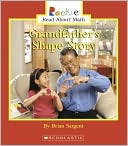
A little girl is introduced to tangrams through her grandfather's "Shape Story." As the story goes, a poor man in a far away country found pleasure in life's simple things. One day, as he was sitting around, the man heard someone calling for help - a rooster, seeking shelter from a troublesome fox. The man took in the rooster to his home, closing the windows and using only candlelight to see. Together, the two sit at a table, the man drinking tea. The rooster is so thankful for the man saving his life, he wants to grant the man one wish. The man thinks and thinks about what his one wish should be. However, rather than actually revealing the wish to his granddaughter, he passes the tangrams along and tells her you choose, encouraging the little girl be creative with creating something from the tangrams.

This book is ideal to use when introducing tangrams to children for many reasons. First, the tangram puzzle is introduced as a "whole" square, but all of the different shape pieces can be detected due to their coloration. Secondly, the pieces of the tangram puzzle are separated and labeled so children have the opportunity to become familiar with the shapes. Finally, all of the illustrations are made from colored tangrams, allowing children to visibly see the how different shapes put together can "form" objects.

Learning/Reading Activity:
  • Print off the tangram puzzle, found here. I would suggest printing the puzzle on cardstock or heavy weight printer paper so it is more durable.
  • Have your child color the puzzle using the following directions: 1 large triangle red, 1 large triangle blue, 2 small triangle red, 1 small triangle blue, 1 medium triangle yellow, 1 parallelogram yellow, 1 square green.
  • Using page 6 of Grandfather's Shape Story, help your child label each of the pieces of the tangram puzzle. This will allow them to become familiar with the different shapes.
  • Allow your child(ren) to experiment with the tangram pieces - encourage them to play around with the shapes and see what they can "make." Allowing them freedom to explore the "tools" freely some will ensure that when you do try to use the tangrams educationally, they will be less apt to "play" while you're teaching!


If you're interested in finding out more information about any of the books reviewed or if you'd like to purchase the books, click the cover image for a link to Amazon.com. I am an Amazon Affiliate, so any purchases you make after clicking these images will result in my receiving a small percentage of the sale price!

Wednesday, October 7, 2009

National Metric Week

National Metric Week is celebrated from October 5-11 in order to maintain an awareness of the importance of the metric system as the primary system of measurement for the US. Annually, the week of the 10th month containing the 10th day of the month. For more information visit, www.metric.org
-The Teacher's Calendar, 2008-2009

Murphy, Stuart J.
Polly's Pen Pal.
2005.
HarperCollins Publishers.


Summary from Barnes & Noble:

Polly's pen pal, Ally, is 125 centimeters tall, weighs 25 kilograms, and lives 450 kilometers away — and Polly is determined to find a way to visit her! A story of long-distance friendship introduces basic metric measurements to children.

I've always been a big fan of Murphy's MathStart series, but this one just didn't strike me... it just didn't seem as great as the others I've reviewed. However, that being said, it is definitely one that I'd include on a unit on measurement (metrics), I just wouldn't use it as an introduction to metrics! It's a good story and I definitely think kids will take away something from it, but they do need to have a basic understanding of metrics before-hand or they will be very confused by what's going on!

Schwartz, David.
Millions to Measure.
2003.
HarperCollins Publishers.
Guided Reading Level: O


Summary from Barnes & Noble:

Your favorite wizard is back -- and ready to explore the invention of length, weight, and volume measurements. How tall is Moonbeam, the unicorn? How long are the whiskers of Jello, the cat? And just how heavy is that darling hog? Tons and teaspoons and ounces and feet and yards and miles ... what a headache! With millions of things to measure, wouldn't one standard system be simpler? With another wave of the wand, Marvelosissimo introduces you to the world of metrics and makes it easy to understand the basic pattern of meters, liters, and grams. And with Steven Kellogg's playful and delightfully detailed illustrations, measuring has never been such a blast!

This book is exactly the opposite of Polly's Pen Pal... it is definitely worth sharing as an introduction to the metric unit in math! It not only goes into details about the system, but I think children will be drawn in from the get-go as they learn how the metric system was founded. It's definitely worth sharing - children will likely love the facts that they find within!

Lesson Plans/Learning Activities:
If you're interested in finding out more information about any of the books reviewed or if you'd like to purchase the books, click the cover image for a link to Amazon.com.

Friday, August 7, 2009

Vacation Week for Me (and for Your Child's Imagination)

I'm in Myrtle Beach for the week... and since I'm on vacation, I thought I'd share one of the "Literacy Book Bags" I've created for the 3rd grader I've been tutoring in reading this summer. I created the book bag at her independent reading level (determined by Running Records and Fountas and Pinnell guided reading levels), which falls between H and I. Even if your child reads at a different level, or you're not sure how to determine their reading level, the books are great to be shared as a read-aloud! The bag I've chosen to share with you contains five books, are all beach-themed. Each book in the bag focuses on a different aspect of a school curriculum.

Hopefully you will have as much fun completing these activities with your children as I did in creating them and/or putting them together.

Ashman, Linda.
To The Beach!
2005.
Houghton Mifflin Harcourt.
Focus on School Curriculum: Read-Aloud, Fill-In Activity
Guided Reading Level: H


Summary from Barnes & Noble:

A forgetful family is sure to have fun at the beach--if only they can get there!

Follow-Up Activity:
Lionni, Leo.
On My Beach There Are Many Pebbles.
1995.
HarperCollins Publishers.
Focus on School Curriculum: Art
Guided Reading Level: I


Summary from Barnes & Noble:

Take a look. And another. And another. Are those ordinary pebbles you see, lying on an ordinary beach? Or are they hearts and gift-wrapped packages, numbers, letters, and the faces of friends? Take a look. And another.

Follow-Up Activity:
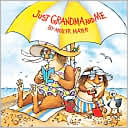
Mayer, Mercer.
Just Grandma and Me.
2001.
Random House Children's Books.
Focus on School Curriculum: Reading Comprehension - Sequencing
Guided Reading Level: I


Summary from Barnes & Noble:

Little Critter and his grandmother spend the day at the beach in this funny-and-true picture book about Mercer Mayer's popular character. Little Critter is a good helper, even at the beach. When his grandmother's hot dog falls in the sand, he washes it off in the ocean. He promises to blow up the inflatable seahorse but needs a little help in the end. The joys and mishaps of a special summer day with Grandma are all brightened by Little Critter's sunny disposition.

Follow-Up Activity:
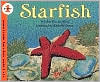
Hurd, Edith Thatcher.
Starfish.
2000.
HarperCollins Publishers.
Focus on School Curriculum: Science
Guided Reading Level: I


Summary from Barnes & Noble:

Brickman has done startling new cutpaper collage illustrations for Hurd's beginningreader book on starfish. Watercolor washes, marbling techniques, and shocking colors portray the starfish in all their chromatic glory, while the simple text points out their intrinsic oddities, such as the fact that they can regrow lost limbs.

Follow-Up Activity:
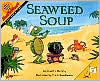
Murphy, Stuart J.
Seaweed Soup.
2001.
HarperCollins Publishers.
Focus on School Curriculum: Math - Problem Solving
Guided Reading Level: I


Summary from Barnes & Noble:

It's slimy. It's smelly. Its green and it's gooey. It's seaweed soup — and its Turtle's favorite lunch!

Turtle has made enough seaweed soup for everyone. But it looks awful and smells worse! Nobody wants to even taste it. How can they tell Turtle without hurting his feelings?

As Turtle serves lunch to his reluctant guests, young readers can learn about matching sets (also called one-to-one correspondence) by keeping track of all the different bowls, cups, spoons, and napkins on the table. Lighthearted art and a surprise ending make this a story readers will eat up.

Follow-Up Activity:
If you're interested in finding out more information about any of the books reviewed or if you'd like to purchase the books, click the cover image for a link to Amazon.com.

Thursday, April 23, 2009

National Coin Week

It's National Coin Week... So I've got books for almost all the coins! I couldn't find anything for the quarter, so I picked up The Penny Pot, as it focuses on counting coins in general.
Brennan-Nelson, Denise.
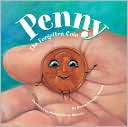
Penny: The Forgotten Coin.
2003.
Sleeping Bear Press.


Ooooh, how I wish I had a copy of this for myself! It's an incredible book but it's only out in hardcover edition... and that isn't in my budget right now... :( . This is really one of the cutest stories I've ever read and not to mention the wealth of information that's found within the pages! There's so much to learn and so many cool activities that could be done with kids!

John and Joey are out riding bikes when John spots a penny on the floor. Joey hassles John about picking it up, claiming,
Big deal! Dad says you can't do anything with a penny these days.
John ignores the tease and not only picks the penny up, but adds it to the other treasures in his blue jeans pocket. Now, Penny's being teased by the other treasures and it's making her feel sad. To try and mask her sadness, Penny begins to relive the good times in her mind (this is where there's so much to be learned)! Being clutched in Rebecca's hand at the penny store (the days of penny candy)... Visiting funny and unusual places (inside the pocket of penny loafers)... watching the races (from the penny rides)... Before she realizes it, Penny is able to recognize that she's not like all the other treasures, as the thoughts of the Red Cross "Every Penny Counts" campaign fills her mind. And then... John and Joey need a coin to toss to see who goes first... and that's when Penny discovers her place among the treasures inside John's pocket!

Some Activities I Have Created/Imagined Based on the Book:
  • Why not open a penny store with traditional penny candies? Places like BJ's and Sam's Club still sell that kind of candy!
  • Have an "Every Penny Counts" penny drive at school and donate the funds to a local cause.
  • Give the kids a piggy bank and encourage them to bank all their pennies. This could then be used on a rainy day or saved for a special trip.
  • Find an old pair of penny loafers from a thrift shop. Insert a penny into that pocket and have kids imagine one of the funny and unusual places that Penny has visited. Have them write about this place in the form of a diary entry. Join all of the entries together and title the diary "The Adventures of Penny."
  • Rather than telling kids what E Pluribus Unum means, use it as a bonus question and have kids research what the phrase means.
  • Create a wishing well of sorts in the classroom. Allow students to throw pennies in the wishing well, but for each penny they drop, they write their wishes in the form of one paragraph using proper grammer and punctuation.
  • Another bonus question could be take from the book as well. "The Lincoln Memorial was added to the back of the penny to mark Lincoln's 150th birthday. Do you know what year that was?" Have students do math to figure out what year would have been celebrating Lincoln's 150th birthday.
Morrison, Taylor.
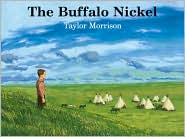
The Buffalo Nickel.
2002.
Houghton Mifflin Company.
Guided Reading Level: S

This book is very informative, as it shares information that I didn't even know about until reading! Did you know that new coins can only be minted every 25 years? Or the work that goes into making a press for a new coin? My gosh, no wonder they're only minted every 25 years! While the book focuses on all of this, the story behind the Buffalo Nickel is really what the book is about!

Creator of the Buffalo Nickel, James Fraser is the focus of this book, as it follows his life - childhood through his adult years and the events leading up to his creation of the buffalo nickel. During his childhood, James lived with his parents and little sister in the Dakota region, facing herds of buffalo and Indians, the ultimate plan behind the Buffalo Nickel.

I think this book might seem a little distant to children, as many of them probably have no experience with or have ever seen a buffalo nickel. I don't even think I've seen one myself! If you could show students a buffalo nickel, they might express more interest in this book and it would be worthwhile, because it is a great story!

Lesson Plans/Reading Activities

Ziefert, Harriet.
You Can't Buy a Dinosaur with a Dime.
2003.
Blue Apple Books.


This is a great book for teaching kids about saving money by using a bank.
Clink. Clink. Clink. Clink.
Clink, clink, clinkity!
Money saved in a bank
makes your brain think-thinkity!
Do you have kids who want every new toy or game? Or always want candy from the store? Why not get them interested in math and money by encouraging them to save change and then have that be their spending money once a month for shopping trips. They'll learn great skills, such as the worth of money, hard work and not to mention, learn counting money at the same time! This book is perfect for such a plan to make shopping trips more educational and not all about the kiddies!

Other Activities to use with You Can't Buy a Dinosaur with a Dime:
Murphy, Stuart J.
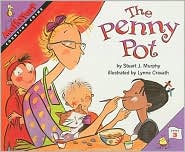
The Penny Pot.
1998.
HarperCollins Publishers.

Guided Reading Level: K

I'm really starting to enjoy these books that are part of the MathStart series! In this book by Stuart J. Murphy, students will have plenty of chance to practice counting coins up to fifty cents. I love these books because you can actually read the story as if it were a math problem children are trying to solve on their own. Read the story, don't show the pictures, and have the students solve the mystery on their own... Will Jessie find enough pennies in the penny pot to get her face painted (hint: she needs 11 cents)?

Jessie is at the face-painting tent at the school fair, anxiously waiting to get her face painted. The cost? Fifty cents... and Jessie only has thirty-nine cents because of that ice cream cone she bought earlier. As her friends show up to get their faces painted, they willing place their extra pennies into the "Penny Pot" so that someone in need will have the use of them. Each time, as the friends get ready to get their faces painted, they count their change (depicted as life-sized at the top of the page for readers) and deposit the extra into the "Penny Pot." Follow along as readers take this journey and practice counting money at the same time!

Lesson Plans/Reading Activities:

If you're interested in finding out more information about any of the books reviewed or if you'd like to purchase the books, click the cover image for a link to Amazon.com.

Wednesday, April 22, 2009

Earth Day

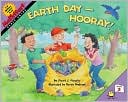
Murphy, Stuart J.
Earth Day - Hooray!
2004.
HarperCollins Publishers.


The students in Mrs. Watson's Save-the-Planet Club are planning an Earth Day Celebration that will take place at Gilroy Park. However, the park is in no condition for a celebration and the students must clean up the park and get it ready. Once they begin working on cleaning up the trash and recyclables, they decide the park needs some sprucing up. They come up with the idea of collecting cans that can be redeemed for money and spending the money on flowers to plant in the park. The adventure takes readers on the journey of the Save-the-Planet Club members while introducing/reinforcing the concept of place value.

Place value, from the experience I've had with it, is one of the hardest math subjects to teach... at any grade level! This book really does a great job showing the concept through the use of different sized garbage bags. I could definitely see myself using this in the classroom on Earth Day as a math activity (even if the place value unit has already been completed, there's always room for review and more practice)!

Lesson Plans/Reading Activities:

Perez, Monica.
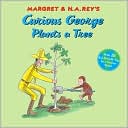
Curious George Plants a Tree.
2009.
Houghton Mifflin Harcourt.


Although it was released in March, I've been holding off on a review, as it seemed perfect for my Earth Day post... and it is! Someday, when I have one, I will be using this book as read aloud on Earth Day. The 20 tips for living green that are provided on the last page will definitely open up the door for discussion and allow students to start thinking about themselves living green!

It's been a while since I've read Curious George! And while this book wasn't written by Margret & H.A. Rey, Monica Perez did a wonderful job writing the same style! There's lots to be learned in this book as Curious George sets about participating in the museum's Earth Day Rally.

George and the man head out to the museum for a day of exploring and to check out the new special exhibit. When they get there, George naturally heads to his favorite exhibits first: the rocket room, the mirror maze and the butterfly space. Then they move on to the special exhibit... How YOU can take care of our Planet. The illustration for this section of the book really have the capabilities of allowing children to almost imagine they are there, seeing the exhibit first hand. And the facts to be gained? Wonderful!

Lesson Plans/Reading Activities:

King, Stephen Michael.
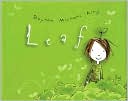
Leaf.
2009.
Roaring Brook Press.


As I initially started reading the book, I was like, what? It made no sense to me... but, I stuck it out, and I'm so glad I did, because the ending is where it all happens! This is definitely a cute book for kids!

Mom's broken out the scissors and a little boy is now expecting a haircut. Knowing what's in store, he dashes away from his mother and hides in the bushes. While he's hiding, a bird plants a seed atop his head, which soon begins to spout. Eventually the boy can no longer hide from his mother and her plans for a haircut. When she cuts off his hair, he takes the sprout and plants it into the ground. As time passes, we see the sprout as it grows, aging with the little boy who turns into a teenager. Years later, as he has a family of his own, he returns to the tree he sprouted and shares his story with his own family.

This really was a darling story... it's not really something I could share in a classroom, as the book is somewhat small for sharing just the pictures as a whole-group deal. However, I think it'd make for great sharing as a family - you could discuss the changes that occur over time in a family... or look at the Earth Day possibility... how will planting a seedling have an impact on the Earth years from now?

Earth Day Lesson Plans/Worksheets

If you're interested in finding out more information about any of the books reviewed or if you'd like to purchase the books, click the cover image for a link to Amazon.com.