Showing posts with label Time. Show all posts

Monday, September 21, 2009

Mathematical Monday

I've had these three books hanging around for some time now... all three are math-related, so I figured what better way to share them than having a "Mathematical Monday" post?!
Cleary, Brian P.
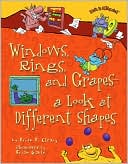
Windows, Rings and Grapes - a Look at Different Shapes.
September 2009.
Lerner Publishing Company.


Summary from Barnes & Noble:

In this humorous look at shapes, Brian P. Cleary and Brian Gable introduce circles, ovals, triangles, squares, and rectangles. The comical cats of the wildly popular Words Are CATegorical® series explain how to identify each shape and provide loads of examples. Peppy rhymes, goofy illustrations, and kid-friendly examples make shaping up a snap!

This book definitely is a great one to use when teaching shapes, so I would say it would be appropriate for ages 4-7. Rather than using the book in its entirety, I would break up the different shapes taught over the course of several days, or they will become too complex for children to remember. The different shapes are taught through rhyming text and concrete objects are used as examples for each shape, allowing ample opportunity to make connections between shapes and everyday objects!
A circle is round,
like the dot on this gown,
like a Hula-hoop, pie,
or some rings,
the door on this dryer,
a bicycle tire.
The circle forms
all of these things.

There's not one straight line
in a circle's design.
It's just a continuous bend.
It's looped and it's curved,
and when closely observed,
you'll find no beginning or end.

If two dogs would fetch one
and lengthen
and stretch one,
an oval would b
e its new shape.
Learning Activities:
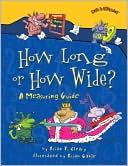
Cleary, Brian P.
How Long or How Wide? A Measuring Guide.
September 2009
Lerner Publishing Company.


Summary from Barnes & Noble:

Brian Cleary and Brian Gable bring their trademark sense of humor to the subject of measuring length. A rhyming text filled with funny examples explains how to use and compare metric and U.S. customary units of length. Readers are also introduced to the tools they need to measure length—rulers, metersticks, and more.

This book is appropriate for children a bit older, I'd say probably ages 7-12, as the concept is a bit trickier. Children need to be somewhat familiar with measurement in order to take the most from this book. Definitely a great book to use when introduce different measurements or even to reinforce the topic! I think the book would be most useful if students are given a ruler and allowed the opportunity to measure different objects using given measurements - millimeters, decimeters, centimeters, inches, etc.

Learning Activities:
Harris, Trudy.
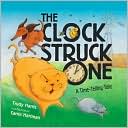
The Clock Struck One: A Time-Telling Tale.
September 2009.
Lerner Publishing Company.


Summary from Barnes & Noble:

When the clock strikes one, a fun-loving mouse runs up the clock. But what happens when the clock strikes two? A cat gets hungry for mouse-tail stew . . . and the chase is on! Hour by hour, more animals - and even a few people - join in. The crowd charges into the barnyard, dashes through the kitchen, and eventually heads right into the middle of town. Keep your eye on the many clocks in this book and follow along until this twelve-hour race comes to a surprising end!

This book would be perfect to use to reinforce time telling practice! The familiar nursery-rhyme on page one will have students chuckling, but the rhymes only get funnier as the story goes on!
Hickory dickory dock,
a mouse ran up the clock.
The clock struck ONE.
He said, "What fun!"
(But the mouse was in for a shock.)

Hickory dicory doo, the grandfather clock struck two.
It woke the cat, who sprang from his mat,
hungry for mouse-tail stew.

Hickory dickory dore,
the dashed across the floor,
splattering food (how terribly rude)
as the cuckoo cuckooed four.
I would read the book first with students, so they are familiar with the rhyming text and notice the clock on each page, how the time is noted. A day later I would reread the book with students, giving them each a Judy Clock. However, instead of reading the book from front to back, I would read the pages randomly, asking the children to make their Judy Clock read the time that is read in the riddle.

Learning Activities:
If you're interested in finding out more information about any of the books reviewed or if you'd like to purchase the books, click the cover image for a link to Amazon.com.

Thursday, July 2, 2009

Jean Craighead George's Birthday

Born in Washington, DC on July 2, 1919, Jean Craighead George celebrates her 90th Birthday today!

George, Jean Craighead.
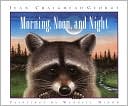
Morning, Noon and Night.
1999.
HarperCollins Publishers.


Jean Craighead George, who is most famous for these wonderful wildlife stories, shares with readers the cycle of a day - morning, noon, afternoon, evening and night. In the morning, readers learn about how animals start their day.
The stork puts down his other foot.
The killdeer stretches her white-striped wings,
and the cardinal sings,
"Good morning, the sun. Cheer, Cheer!"
At noon, we see how mid-day takes over the animals and they settle for a mid-day siesta.
The birds stop singing.
The antelopes doze.
The lizard hides. The snake lies still,
and the ground squirrels rest in their burrows.
In the afternoon, we watch how animals wind down after a day of work.
The bison ambles to the water,
and the prairie dog romps with her young.
Before long it's evening - the sun is setting and the earth is turning from light to dusk.
The deer walks in twilight.
The jackrabbit leaves her hideout to eat.
The elk grazes,
and the brook trout swallows
his last bug before dark.
Every day must come to a close.
Good night, the night,
when the earth has turned away from the sun
and the night folks are up.
This book would be a wonderful bedtime story for children who are reluctant to head to bed each night, as it reassures them that another day is just around the corner!
Good night, the night,
when the earth has turned away from the sun
and the night folks are up.

The bat dips and flies.
The wolf frolics over the mountains.
The elephant seal dives deep for food,
and the owlet sings,
"Who, the night, Who, Who?"

And the earth keeps on turning,
on turning, on turning.

Good morning, the sun. "Cheer, cheer."
George, Jean Craighead.
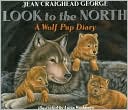
Look to the North: A Wolf Pup Diary.
1997.
HarperCollins Publishers.

The more of George's work that I read, the more I love her writing style! There is so much information stored within the pages of her books... and it's written in such a manner that it will appeal to children - they're getting their dose of non-fiction, while reading about cute, (seemingly) cuddly creatures - an all around plus as it's often hard to get children reading non-fiction!

Readers follow the first year of a wolf pup's life in this book, written in diary format. Throughout the story, readers are prompted to "look to the north," as the events of these particular wolf pups lives are taking place far to the north, at Alaska's Alpine Tundra. George ensures that children will be able to relate to the season she's mentioned by picking topics from each season that are of interest to children. The different seasons that are mentioned allow readers to connect with the different events in the life of the wolf pups, Boulder, Scree, and Talus, in this story.

1 Day Old...
When you see dandelions turning
silver, look to the north, Wolf pups
are being born.
10 Days Old...
When the yellow warblers return
from the south, look to the north.
The eyes of the wolf pups are
opening.
2 Weeks Old...
When the redwings are flashing their bright shoulder
badges, look to the north. The mother wolf will take
brief vacations.
3 Weeks Old...
When the srping azure blue butterflies are flitting,
look to the north. The wolf pups can hear.
4 Weeks Old...
When you see baby robins, look to the north. Wolf pups
are almost weaned.
7 Weeks Old...
On the longest day of the year, look to the
north. Wolf pups are outdoors playing.
9 Weeks Old...
When firecrackers shoot skyward,
look to the north. Wolf pups are learning wolf talk.
10 Weeks Old...
When you are eating July's abundant corn on the cob,
look to the north. A change is coming to wolfdom.
12 Weeks Old...
When the crickets are chirping, look
to the north. Wolf pups are learning adult wolf talk.
3 Months Old...
When you see the early goldenrod
blooming, look to the north. Wolf
pups are bonding.
16 Weeks Old...
When you are eating fresh blueberries, look to the
north. Wolf pups are practicing their hunting skills.
4 1/2 Months Old...
When you are back in school, look to
the north. Wolf pups are leaving their
summer dens.
6 Months Old...
When you are out trick-or-treating, look
to the north. Wolf pups are enrolled in
the wolf kindergarten of hunting.
7 Months Old...
When you are eating turkey and
watching football, look to the north.
The wolf pups are full grown.
10 1/2 Months Old...
When the day and night are of equal length, look to the
north. New pups are on their way.
Along with the connections children will be able to make to points in their life and the wolf pups, children will also learn great deals of information about the wolf pups at these different point in their life! Very educational!

If you're interested in finding out more information about any of the books reviewed or if you'd like to purchase the books, click the cover image for a link to Amazon.com.