Showing posts with label Colors. Show all posts

Friday, November 5, 2010

Great Bilingual Books

Expose your children to the Spanish language using bilingual picture books!

Walsh, Ellen Stoll.
Mouse Paint/Pintura de raton.
June 2010.
Houghton Mifflin Harcourt.
Review copy provided courtesy of publisher.


Three adventurous white mouse take readers on a journey exploring the act of color mixing. As they dip into different color cups, readers will find great join and excitement in the new colors that are formed - orange, green, purple and even brown! The simple text introduces secondary colors through the mixing of the primary colors. This book is perfect for preschool children learning about colors. It also makes for a wonderful art activity!
  • Get out those finger paints and a large piece of finger paint paper. Using the three primary colors: yellow, red and blue, allow children to explore by mixing colors of their own, after giving them a dollop of each on their plate. Challenge your child(ren) to try and find the combinations that make orange, green, purple and even brown!
Parks, Carmen.
Farmers Market/Dia de mercado.
July 2010.
Hougton Mifflin Harcourt.
Review copy provided courtesy of publisher.


Parks and Farmers Market/Dia de mercado introduce young readers to the concept of a farmers market - from how it works to the items being sold. This book would make for a perfect introduction about fruits and vegetables, how they are grown and who the people are that grow them. You could easily expand upon this book in other ways, as well!
  • Take a field trip to your local farmers market (or produce section at the grocery store). See what fruits and vegetables you can find. Try buying 3 different ones that haven't yet be tried by your family/class. Experiment trying out new fruits and vegetables!
  • Set up a farmers market in your classroom using play fruits and vegetables. Tag each item with a price and have your child(ren) "buy" the items to practice counting with money!
Floyd, Lucy.
Rabbit and Turtle Go To School/Conejo y Tortuga van a la escuela.
July 2010.
Houghton Mifflin Harcourt.
Review copy provided courtesy of publisher.


Similar in aspects to the Tortoise and the Hare, Rabbit and Turtle Go To School/Conego y Tortuga van a la escuela, explore how these two animals take different approaches in a race to school. While ultimately the animals travel in different methods than you might expect - and the race results are likely to be surprising - this is the perfect book to introduce children to the classic, The Tortoise and the Hare. Definitely a fun, simple story that children will likely enjoy!
  • Use a Venn Diagram to draw up a list of similarities and differences between Rabbit and Turtle Go To School/Conejo y Tortuga van a la escuela and The Tortoise and the Hare. See if children can identify what is so ironic about Rabbit and Turtle Go To School/Conejo y Tortuga van a la escuela (Tortoise is the slower of the two animals, yet he wins the race to school)!
The bilingual aspect of these books will allow children to not only see and hear the Spanish language, it also allows them to make a connection between words. The books are perfect for any families you might come across that are bilingual - in my classroom I have an English speaking child with Spanish speaking parents - interesting to say the least! However, providing them with such reading materials exposes the children to their parents' native (first, and only) language and the parents' to the the children's (first, and only) language, allowing them both to learn from each other (and the illustrations of course, that are key for preschoolers to draw conclusions from print and illustration)!


If you're interested in finding out more information about any of the books reviewed or if you'd like to purchase the books, click the cover image for a link to Amazon.com. I am an Amazon Affiliate, so any purchases you make after clicking these images will result in my receiving a small percentage of the sale price!

Friday, June 25, 2010

Colors... Everywhere

The world is 100% full of colors. Everything, everywhere is a color of some sort or shade. In the newest non-fiction series, Colors Everywhere, authored by Kristin Sterling and published by Lerner Books, a few of these colors are shared with readers in some detail. Colors are explored as a part of nature, as human-made (shade mixing). They are also explored in the context of meaning - yellow can portray happiness, mellowness. Red can portray anger or represent the act of being annoyed.

Sterling, Kristin.
Red Everywhere.
March 2010.
Lerner Books.
Review copy provided courtesy of publisher.

Sterling, Kristin.
Black Everywhere.
March 2010.
Lerner Books.
Review copy provided courtesy of publisher.

Sterling, Kristin.
Blue Everywhere.
March 2010.
Lerner Books.
Review copy provided courtesy of publisher.

Sterling, Kristin.
Yellow Everywhere.
March 2010.
Lerner Books.
Review copy provided courtesy of publisher.

The titles listed above are just four of the six titles in the series. Silver and Gold Everywhere and White Everywhere are also a part of the series. The books are actually quite engaging, asking readers questions to get them involved and sharing information of which children can easily relate to. I am definitely considering using these titles in my preschool classroom when introducing/reviewing colors.

Learning/Reading Activity:
  • Use this series as a basis for color collages. Introduce/review the colors explored in the series first, and then branch out and create collages for other colors as well - pink, purple, green, brown, orange, etc. Using the appropriate colored construction paper, have children search for items that represent/show the given color. For example, on red construction paper, have them use newspapers/magazines to show all things red - a red car, an apple, a cherry, tomatoes, crayon, marker, pencil, pen, ladybug, a shirt, pants, shoes, etc. Repeat this activity for all of the colors you want children to learn! It's a fun craft project and will likely introduce children to vocabulary they aren't familiar with as they find new "red" things to add to their collage!


If you're interested in finding out more information about any of the books reviewed or if you'd like to purchase the books, click the cover image for a link to Amazon.com. I am an Amazon Affiliate, so any purchases you make after clicking these images will result in my receiving a small percentage of the sale price!

Monday, June 14, 2010

Pete the Cat: I Love My White Shoes

Book and a downloadable song! And it's very educational, too!

Litwin, Eric.

Pete the Cat: I Love My White Shoes.
March 2010.
HarperCollins Publishers.
Review copy provided courtesy of publisher.


The youngest of children will appreciate the story being shared in Pete the Cat: I Love My White Shoes. Wearing his brand new, white shoes, Pete sets off down the street to take a walk. Along the way, he begins singing,
I love my white shoes, I love my white shoes, I love my white shoes.
However, Pete's so busy singing, he doesn't realize he's come across a giant pile of strawberries... and his shoes are no longer white, they're red! Pete doesn't become upset though, and instead adjusts his song to fit his shoes. As the story continues, Pete runs into numerous other problems, all of which change the color of his shoes, but not his attitude!

This is a perfect story for children, as it deliberately states at the end of the book,
The moral of Pete's story is:
No matter what you step in,
keep walking along and
singing your song.
I think that because the moral is portrayed throughout the story in a simple manner, children will easily understand the message Litwin was trying to share! Coupled with the free I Love My White Shoes download (provided via gift card inside the book), this book will be perfect to use with my preschoolers next fall - colors, actions/consequences, and self-esteem!

Learning/Reading Activity:
  • Download the activity provided by HarperCollins, "Pin the Shoe on Pete." This activity allows each child to design his/her own shoe. Pete is then hung on the wall, students are blindfolded and given the chance to pin (tape) his/her shoe on Pete. Whoever comes the closest to pinning the shoe onto Pete's outstretched paw wins. Give this child the game to take home and share with his/her family.
  • I have created a Color Recognition activity that can be used with your children. Tell my version of the story of Pete, Pete's Color Recognition Story. As you are reading the story, ask your child to use a crayon/marker/colored pencil to color the shoe with the color that is mentioned as you are reading.
  • The curriculum where I teach is High/Scope, encouraging children to be creative. To try and use this book in my classroom, I created an Action-Consequence activity, that allows children to determine what Pete stepped in and what color it changed his shoes. That activity can be downloaded here. I incorporated some of the original Pete the Cat: I Love My White Shoes text, so that the learning can be extended to other classrooms and at home!


If you're interested in finding out more information about any of the books reviewed or if you'd like to purchase the books, click the cover image for a link to Amazon.com. I am an Amazon Affiliate, so any purchases you make after clicking these images will result in my receiving a small percentage of the sale price!

Thursday, June 4, 2009

Anita Lobel's Birthday was Yesterday, June 3

I'm getting really slopping in my posting methods... the nice weather snuck up on me and I'm finding less time for posting... I need a weekend free of activities, but that's not to be the case this weekend... Firemen's Field Days Parade is Friday night, followed by a family cookout and bonfire with two little step-cousins. Saturday evening, I'm heading out to the Syracuse Stage to see one of the seasons last two performances of Crowns - it should be fun... a night on the town usually is... especially at the stage.

Hopefully soon, things will settle down a bit or maybe I'll just take the books and laptop out to the new Adirondack chairs...

Lobel, Anita.
Alison's Zinnia.
1990.
Greenwillow Books.

This is the alphabet book of flowers and girls names, A to Z... and it's really pretty cool!

I don't think boys would find it too interesting, but girls who are interested in flowers or gardening will get a kick out of it! I'm going to share just a brief sample of it with you!
Alison acquired an Amaryllis for Beryl.
Beryl bought a Begonia for Crystal.
Crystal cut a Chrysanthemum for Dawn.
Dawn dug a Daffodil for Emily.
Emily earned an Easter lily for Florence.
The story continues on in such fashion until we finally see the alphabet ending and starting again as
Zena zeroed in on a Zinnia for Alison.
Lobel, Anita.
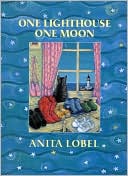
One Lighthouse, One Moon.
2000.
Greenwillow Books.

Divided into three sections, this book would be perfect for a preschool or kindergarten... possibly even a 1st grade classroom!

The first topic? Days of the week. Meshed in with days of the week are colors - perfect for reinforcing two concepts at the same time while allowing children to see the connections being made! This section of the book is also perfect for beginning readers because of it's predictability and repetition.
Black shoes on MONDAY.
Red shoes on TUESDAY.
Blue shoes on WEDNESDAY.
Yellow shoes on THURSDAY.
Green shoes on FRIDAY.
Pink shoes on SATURDAY.
White shoes on SUNDAY.
As you can see from the text alone, it is very predictable, and even if children aren't able to read color words, the illustrations show the colors on a pair of shoes! The only thing I didn't particularly care for in this first of the three parts, was that Lobel started out the week on Monday... I'm just used to considering Sunday the start of a new week...

Topic two is the months of the year... and tied alongside that are the seasons (if you live in a place where you get to experience all four season)! Again, it's perfect for young children (preschool, Kindergarten, maybe 1st graders), although the reading level is a bit more advanced!
In JANUARY Nini caught snowflakes on her nose.
In FEBRUARY Nini avoided kisses on Valentine's Day.
In MARCH Nini listened to winds howling.
In APRIL Nini watched crocuses poke through the ground.
In MAY Nini chased kites in the sky.
In JUNE Nini smelled roses growing on a bush.
In JULY Nini napped under a flag.
In AUGUST Nini dreamed of crayfish.
In SEPTEMBER Nini played in the autumn leaves.
In OCTOBER Nini posed on a pumpkin.
In NOVEMBER Nini smelled turkey.
In DECEMBER Nini waited for good things.
And they came.
Apparently, somewhere in there, Nini had some fun :) , as her "good things" that come turn out to be a new litter of kittens! However, this is perfect for teaching or even just reinforcing months of the year, seasons and, in some cases, the holidays that go along with those months and seasons! Again, the illustrations provide many context clues for perhaps, early readers who are getting used to different methods for recognizing words in a text!

The third and final topic in this book is counting... 1-10. Of course, the illustrations represent objects to show the one-to-one correspondences!
ONE lighthouse stood on a rock in the sea.
TWO boats sailed by.
THREE sailors waved to
FOUR girls dancing on the shore.
FIVE whales blew spouts of water in the air.
SIX pelicans dozed.
SEVEN seagulls bobbed on the waves.
EIGHT geese flew south to avoid early snow.
NINE fisherfolk walked home with their catch.
TEN trees bent in the wind.
And ONE HUNDRED stars and ONE moon lit up the sky.
This might be perfect to get children started with counting and then prompting them to continue counting on to one-hundred to practice for school! I do believe this book will be finding its way into my classroom library!

If you're interested in finding out more information about any of the books reviewed or if you'd like to purchase the books, click the cover image for a link to Amazon.com.