Showing posts with label Steve Jenkins. Show all posts

Friday, August 13, 2010

How to Clean a Hippopotamus

Teach children about symbiosis - how two unusually paired creatures work together to benefit each other (mutualism).

Jenkins, Steve and Robin Page.
How to Clean a Hippopotamus: A Look at Unusual Animal Partnerships.
May 2010.
Houghton Mifflin Harcourt.
Review copy provided courtesy of publisher.


Steve Jenkins and Robin page have a hit with How to Clean a Hippopotamus: A Look at Unusual Animal Partnerships! They tag-team together to teach children all about symbiosis and the various ways in which unusual animals team up to benefit from each other! From the pairing of the hippopotamus and the African helmeted turtle to the pairing of dogs and humans, it seems as though pretty much every aspect of symbiosis is covered!

The book is perfect for readers of all ages, as you can pick and choose which animal relationships you wish to explore or you can read the book in its entirety. The relationships are explained in enough detail that the benefits for each contributing partner are easy to understand, yet the text is presented in a way that is simple to understand! There's something for all to enjoy in this scientifically informative pick!

Learning/Reading Activities:


If you're interested in finding out more information about any of the books reviewed or if you'd like to purchase the books, click the cover image for a link to Amazon.com. I am an Amazon Affiliate, so any purchases you make after clicking these images will result in my receiving a small percentage of the sale price!

Thursday, October 29, 2009

Thursday in Motion

These are some books I've had hanging around for a while now, awaiting a day when there was no themed review to go up! I decided to clump this bunch together because they all focus on some kind of movement and action, making them perfect for an "in Motion" post! They are some very clever books that could easily fit into the classroom or home library!

Cuyler, Margery.
The Little Dump Truck.
September 2009.
Henry Holt and Company.


Summary from Barnes & Noble:

Meet Hard Hat Pete and his little dump truck as they haul stones and rocks, carry debris, and unload at the landfill. It’s hard work, but the little dump truck is ready for action.

The rhyming text and set-up of this book make me think of "I'm a Little Teapot," except it's perfect for boys! What boy doesn't love dump trucks? I could almost see trying to come up with some kind of a little dance for the little men in your life to coincide with the reading of this story, as boys are sure to love it! This is definitely a book that would be a perfect fit in any little boy's library!
Berger, Carin.
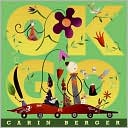
OK Go.

April 2009.

HarperCollins Publishers.


Summary from Barnes & Noble:

In a world of go! go! go! go! go! it's time to stop! and find a new way. Carin Berger's playful new picture book is a jubilant celebration of going green. We live in a world that's constantly in motion - we're constantly doing something to keep busy.

This new book by Carin Berger urges readers to stop - to take a moment and see how our actions are impacting the world around us. However, what makes this book so great are the suggests that Berger suggests to children as ways to stop and re-evaluate our actions in order to "Go Green." This is definitely a great book to use when teaching about saving the Earth!
Schertle, Alice.
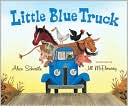
Little Blue Truck.

October 19, 2008.

Houghton Mifflin Harcourt.


Summary from Barnes & Noble:

A little blue truck finds his way out of a jam, with a bit of help from his friends.

Earlier this month, Little Blue Truck was released in board-book format and I'm so glad to see that this happened, as this book is wonderfully appropriate for young children! There's much to be learned here, even through the eyes of a child as young as age 2! Parents and children can work together to learn the sounds that animals make in this book! Not only will they learn all about animal sounds, children will also see the benefits that working together has. Perhaps, they will not be able to connect to the idea in this way, but you could probably get the same lesson across at clean-up time, when everyone works together to clean up. They'll surely be able to understand (in that setting) how much time is saved when you work together.
Schertle, Alice.
Little Blue Truck Leads the Way.
October 19, 2009.
Houghton Mifflin Harcourt.


Summary from Barnes & Noble:

Zooom! Wooeeee . . . ! "Make way!" The big city sure is a speedy, noisy place for a country truck like Blue. Everywhere Blue looks, he sees buses, police cars, taxis, vans, a street sweeper, and even the mayor’s limousine. With everyone pushing to be first, soon there’s a giant traffic jam! But even a wrangle-tangle is no match for Little Blue Truck, who comes to the rescue in true Blue style.

Released on the same day as the board book format of Little Blue Truck, Schertle's latest in the Little Blue Truck series is sure to please just as much! Children should instantly make the connection, as the book starts out in the very same manner as the original,
Horn went "Beep!"
Engine purred.
Friendliest sounds
you ever heard.
This book would be absolutely perfect for Pre-K or Kindergarten teachers to introduce children to the concept of walking in line singe file, as it shows (through the use of various vehicles), the chaos that ensues when everyone thinks they need to be first, rather than being patient and realizing they will all reach their destination eventually. I will definitely keep this book in mind should I ever work with Pre-K and Kindergarten kids, as having "Little Blue" be the line leader, wearing a cardboard stencil necklace of Little Blue's front to represent him being the leader after the mayor's speech and a cardboard rear-view of a taxi, as he represented the end of the parade line, as mentioned by the mayor. Of course, in order for this to be successful in teaching children about walking single file in line and being patient, they'd need to hear the story several times first!
Jenkins, Steve and Robin Page.
Move!

October 18, 2009.

Houghton Mifflin Harcourt.

Guided Reading Level: L

Summary from Barnes & Noble:

Animals move! Follow them as they swing, dance, float, leap, and slide from page to page. Move! is a playful introduction to motion in the animal kingdom that invites young readers to guess some of the unusual ways that animals get around.

This book, recently released earlier this month in board-book format is absolutely perfect for young children (ages 2-5) to share with parents and/or caretakers. The book focuses on a topic which many children observe and can verbalize at a very young age - types of movement (jumping, running, walking, etc). What I particularly liked about this book is that it is very parent-friendly! The last page of the book engages parents to share and discuss with children the question, "...how about you?" Books of this nature allow parents to see the ways in which they books can be used to interact and communicate with their child(ren). I would recommend this book to parents of young children who are searching for ways to begin sharing literature, perhaps as part of a Success by 6 program, coordinated with the United Way.

If you're interested in finding out more information about any of the books reviewed or if you'd like to purchase the books, click the cover image for a link to Amazon.com.

Sunday, October 4, 2009

Monkeys

Kids seem to love monkeys - drawing them, watching them, visiting them at the zoo, even wearing them on their clothes. These two books will surely not disappoint your little monkey-lovers!

Christelow, Eileen.
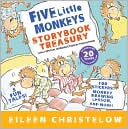
Five Little Monkeys Storybook Treasury.
August 2009.
Houghton Mifflin Harcourt.
Guided Reading Levels:
Five Little Monkeys Jumping on the Bed: E
Five Little Monkeys Sitting in a Tree: F
Five Little Monkeys with Nothing to Do: I
Five Little Monkeys Wash the Car: I

Summary from Barnes & Noble:

This 20th-anniversary treasury features a special introduction and five full-length picture books—Five Little Monkeys Jumping on a Bed, Five Little Monkeys Bake a Cake, Five Little Monkeys Sitting in a Tree, Five Little Monkeys with Nothing to Do, and Five Little Monkeys Wash the Car—as well as a lesson on how to draw your own fabulous monkeys. Sheets of colorful stickers and musical notation round out this amazing collection. It’s the perfect addition to any child’s classic library.

I've always loved Five Little Monkeys Jumping on a Bed and Five Little Monkeys Sitting in a Tree, but wasn't familiar with the other three stories included in this treasury. They're every bit as good as the first two counting-themed stories and I know kids will love them! There's so much that can be done with these stories that they're definitely a choice I'd want to see on school, classroom and home library shelves.

Activities to Use in Collaboration with this book:
  • Five Little Monkeys Jumping on the Bed - Simple subtraction activity. Using construction paper, cut out the shape of a bed. Allow children to decorate the bedspread on their bed by coloring it. Pair students off. Give each pair of students some monkey manipulatives, similar to these. Using the Five Little Monkeys Jumping on the Bed worksheet, students will write number sentences after manipulating the monkeys. They will place 5 monkeys on the bed. Some number fall off and bump their heads. How many are left on the bed. ____-_____=_____. They will continue to do this until they have created all of the possible combinations that start with 5 monkeys on the bed until all five fall off. 5-0=5, 5-1=4, 5-2=3, 5-3=2, 5-4=1, 5-5=0. With older or more advanced students, you could have them do fact families to make the activity level a bit higher.
  • Five Little Monkeys Sitting in a Tree - Jenn, from Ramblings of a Crazy Woman created these craft stick monkeys and an alligator to use with this story. They could be used to for retelling and sequencing the events of the story, or could be used as puppets when singing the song.
  • Five Little Monkeys with Nothing to Do - This is a writing activity. Children will pretend they are one of the five little monkeys with nothing to do. All of their chores are done. Their homework is done. If they could do anything in the world, what would they choose to do? Write in your journal, 5-6 sentences answering this question. Be sure to use sentences, complete with capital letters and punctuation!
  • Five Little Monkeys Bake a Birthday Cake - After reading the story, provide children with this writing activity. Obviously these five little monkeys have no idea how to make a birthday cake. Let's see if you can help them! Write step-by-step directions for "How to Make a Birthday Cake." Read all of the writing samples that are turned in. The student who provides the directions closest to those needed to actually bake a cake "wins," however, the whole class will really win. That student gets to choose which kind of cake the class will bake - chocolate, vanilla, or strawberry and what kind of icing to frost the cake with. Then, together as a class, prepare, bake and enjoy the cake!
  • Five Little Monkeys Wash the Car - The five little monkeys are washing the car because they want to help their mother sell it so they can buy a new one. Organize a class car wash to raise money for a good cause. This will help children see the importance of giving back to the community and working as a team to accomplish a goal.
Jenkins, Steve.
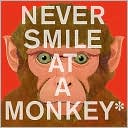
Never Smile at a Monkey: And 17 Other Important Things To Remember.
October 2009.
Houghton Mifflin Harcourt.


Summary from Barnes & Noble:

When it comes to wild animals, everyone knows that there are certain things you just don’t do. It's clearly a bad idea to tease a tiger, pull a python's tail, or bother a black widow spider. But do you know how dangerous it can be to pet a platypus, collect a cone shell, or touch a tang fish? Some creatures have developed unusual ways of protecting themselves or catching prey, and this can make them unexpectedly hazardous to your health. In this dynamic and fascinating picture book by Steve Jenkins, you'll find out what you should never do if you encounter one of these surprisingly dangerous animals.

Steve Jenkins' books take on a whole new approach to children's non-fiction. Had these been around when I was young, I would probably be infatuated with non-fiction... however, even though I wasn't that fortunate, today's children are! This book provides today's children with so many interesting facts about things you should never do to/with animals! Definitely a great book to share!

Activity to Use in Collaboration with this book:
  • Assign each child one of the animals from the book. In addition to the information found within this book, ask the child to research and find more information about the animal, completing the research worksheet attached here, courtesy of West Hartford Public Schools. Once they have done that, assign a creative writing project to the student(s). The writing assignment is for children to create a story with the title, "I __________ a ___________," filling in the blanks with whatever animal and the advice Jenkins gave not to do. Children then need to be creative in coming up with a story about this animal and all that they learned about the animal. An example can be found here. I gathered my black bear information from Wikipedia for time's sake, but certainly you'd want students to consult a variety of resources to gather their information before completing the writing assignment.
If you're interested in finding out more information about any of the books reviewed or if you'd like to purchase the books, click the cover image for a link to Amazon.com.

Monday, May 18, 2009

Non-Fiction Monday!

I've had both of these books sitting around for some time now, waiting for a non-fiction Monday review... however, they've all passed me by until today!

Woods, Michael and Mary B.
Seven Natural Wonders of North America.
2009.
Lerner Publishing, Inc.


This book is a great resource for middle-grade children doing research projects about one of the Seven Natural Wonders of North America of for teachers of youngers students to use as a read aloud when focusing on one of the seven natural wonders.

There is much to be learned about each of the Seven Natural Wonders of North America:
  1. Dinosaur Provincial Park in Alberta, Canada
    Readers find out about:
    • ancient reptiles
    • dinosaur boneyard
    • sedimentary rock where bones are encased
    • paleontologists finds
    • preserving this natural wonder
    • what a visit to Dinosaur Provincial Park might consist of
  2. The Grand Canyon in Arizona
    It's gorgeous to see and almost as fun to learn about:
    • What makes the Grand Canyon Grand?
    • How was the Canyon carved?
    • The Canyon is a "storybook" of the Earth's history
    • Various groups who have resided in the Canyon
    • Worries about this natural wonder
    • What/How to explore during a visit to Grand Canyon National Park
  3. Niagara Falls in Ontario, Canada and New York
    Also known as the "Honeymoon Capital," readers of all ages will enjoy discovering Niagara Falls:
    • learn about the natural history - dating back to the Ice Age
    • the importance of location in its popularity (only 2 1/2 hours from me!)
    • tightrope walking and barrel dropping stunts
    • the source of power that the falls provide
    • positive/negative of the falls
    • visitors attractions/activities
  4. Pacific Rim National Park in British Columbia, Canada
    Readers can learn about:
    • dangers faced by ships trying to cross the rim
    • rescue and hiking trails built by the government
    • the rain forest located within the park, as well as lakes, rivers, beaches, forests, meadows, mountains and valleys
    • the Broken Group Islands, a part of the park
    • what is/can be done to preserve Pacific Rim National Park
  5. Paricutin Volcano in Michoacan, Mexico
    Learning about Volcanos:
    • What happens when a volcano erupts?
    • Destruction caused by volcanos
    • Volcanos as a tourist attraction
    • What makes a volcano erupt?
    • What is Volcano Country?
    • Settlers in/around Paricutin
  6. Redwood Forests in Oregon and Northern California
    Children will love learning about:
    • the age of redwood trees
    • the ability of redwood trees to withstand very high winds
    • the home for plants and animals within these trees
    • the various uses of wood provided by the redwood trees
    • what is being done to protect the Redwood Forests
    *** Couple this section of the book with Jason Chin's Redwoods for a well-rounded lesson on the Redwood Forest!
  7. Yellowstone National Park in Wyoming, Montana, and Idaho
    Exploring Yellowstone (through literature):
    • Where did the name "Yellowstone" come from?
    • Wonders within this Natural Wonder - Old Faithful, Giant, Giantess
    • Wildlife located within the Park
    • Protecting this tourist attraction
As you can see, there's a great deal that children will learn when browsing this book. It's not only great for children though... if you're a traveler, why not try and visit all of the Seven Natural Wonders of North America and create a scrapbook of your travels? Heck, this book even encourages readers to "Choose an Eighth Wonder" after reading and/or visiting the first seven!
Now that you've read about the seven natural wonders of North America, do a little research to choose an eighth wonder. You may enjoy working with a friend.

To do your research, look at some of the websites and books listed on pages 76 and 77. Look for places in North America that:
  • are especially large
  • are exceptionally beautiful
  • were unknown to foreigners for many centuries
  • are unlike any other place on earth
You might even try gathering phots and writing your own chapter on the eighth wonder!
How cool of a project would that be for older children, perhaps in the 4th-12th grades?!?!

Jenkins, Steve.
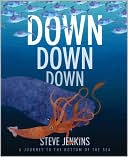
Down, Down, Down: A Journey to the Bottom of the Sea.
2009.
Houghton Mifflin Harcourt.


Steve Jenkins does not disappoint in his latest non-fiction children's work! Readers are given a brief introduction about the ocean before setting sail on a virtual submarine of sorts, exploring the ocean to its greatest depths, The Marianas Trench, located 35,838 feet below the surface.
Oceans cover more than two-thirds of the globe's surface and well over half the planet lies beneath water more than a mile (1 1/2 kilometers) deep. We have explored only a small fraction of the oceans. In fact, more humans have walked on the moon than have visited the deepest spot in the sea.
This book is perfect for any child who loves the ocean and sea-life. It is very factual and will provide children with the chance to test your knowledge of ocean life!

If you're interested in finding out more information about any of the books reviewed or if you'd like to purchase the books, click the cover image for a link to Amazon.com.

Tuesday, March 31, 2009

Steve Jenkins' Birthday

Author and illustrator Steve Jenkins was born in Hickory, NC on March 31, 1952. Jenkins attributes his love of books to the lifestyle he lived as a young child. With a father in the military, Jenkins traveled around a lot and didn't have many friends. On his website, he states that his ideas for children's books stemmed mostly from the questions his own children asked him when they were little. I've decided to share with you today, three of Jenkins' works.

Jenkins, Steve.
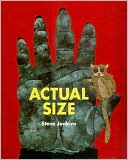
Actual Size.
2004.
Houghton Mifflin Company.
Guided Reading Level: L


Immediately, Jenkins introduces readers to the concept of this book - allowing readers to see what the actual size of animals looks like in comparison to ourselves. The illustrations are simple, torn paper pieced together to form the animals or insects mentioned throughout. Coupled with the illustrations, Jenkins provides very basic details about the animals, typically how big they are and how much they weigh. At the end of the book, more details are provided for the avid animal/insect lovers! This book will be a hit for any child who shows an interest in animals and bugs!

Lesson Plans/Reading Activities:

Jenkins, Steve and Robin Page.
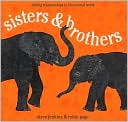
Sisters & Brothers.
2008.
Houghton Mifflin Company.


In yet another non-fiction picture book, Jenkins shares with youngsters more information about animals and insects. How many are born in each litter? How do they work together? How do they stay together? Why are some only children while others are identical quadruplets? The book answers all these questions... and a whole lot more, including basics about each animal: where they live, how big they are, how much they weigh, etc.

This book would be wonderful to have for any child who is an animal love, curious and inquisitive by nature or even for a classroom to introduce students to an animal research project!

Jenkins, Steve and Robin Page.
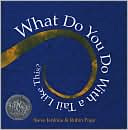
What Do You Do With a Tail Like This?
2003.
Houghton Mifflin Company.
Guided Reading Level: J

Another wonderful book by Steve Jenkins! This might even have been my favorite of the three! Children will learn quickly that different animals have different uses for their body parts. Not only will they learn that different body parts have different uses, they'll be able to tell you what each animal uses that body part for! This would be perfect in perhaps a K-2 classroom when students are learning about how animals can adapt to their environments to live.

Lesson Plans/Reading Activities:
If you're interested in finding out more information about any of the books reviewed or if you'd like to purchase the books, click the cover image for a link to Amazon.com.